


Welcome back, aspiring and current Chiefs of Staff! 👋
If you're reading this as a forward or from LinkedIn, subscribe to Ask a Chief of Staff to get these insights directly in your inbox. Join 13,500+ Chiefs of Staff who trust us for actionable insights.
Our annual compensation survey results are in! This year, we collected data from 5️⃣ 0️⃣ 0️⃣ ➕ Chiefs of Staff to provide you with comprehensive insights into compensation trends across the industry.
This year, we partnered with Notion to bring you the this report. Eligible readers of Ask a Chief of Staff can get 6️⃣ months free of Notion Business + AI.
Let’s dive into the key findings from our fourth annual Chief of Staff Compensation Survey ⬇️
💵 How Much Does a Chief of Staff Make?
Over the past couple of months, we surveyed current Chiefs of Staff to help both current and aspiring Chiefs of Staff know their market value and use this information to help negotiate or re-negotiate their salaries.
The full report is available in the link at the top of this newsletter, but in this issue, we’ll be highlighting a few specific trends and points of interest.
This year, we collected data from 5️⃣ 1️⃣ 2️⃣ Chiefs of Staff, with North America representing the majority of responses and remote roles remaining strong. While we received responses from APAC, EMEA, and other international regions, we’ve focused primarily on North American data where we had the largest sample size.
1️⃣ Chief of Staff Tenure Matters More Than Overall Work Experience
The data shows a compelling correlation between Chief of Staff tenure and compensation.
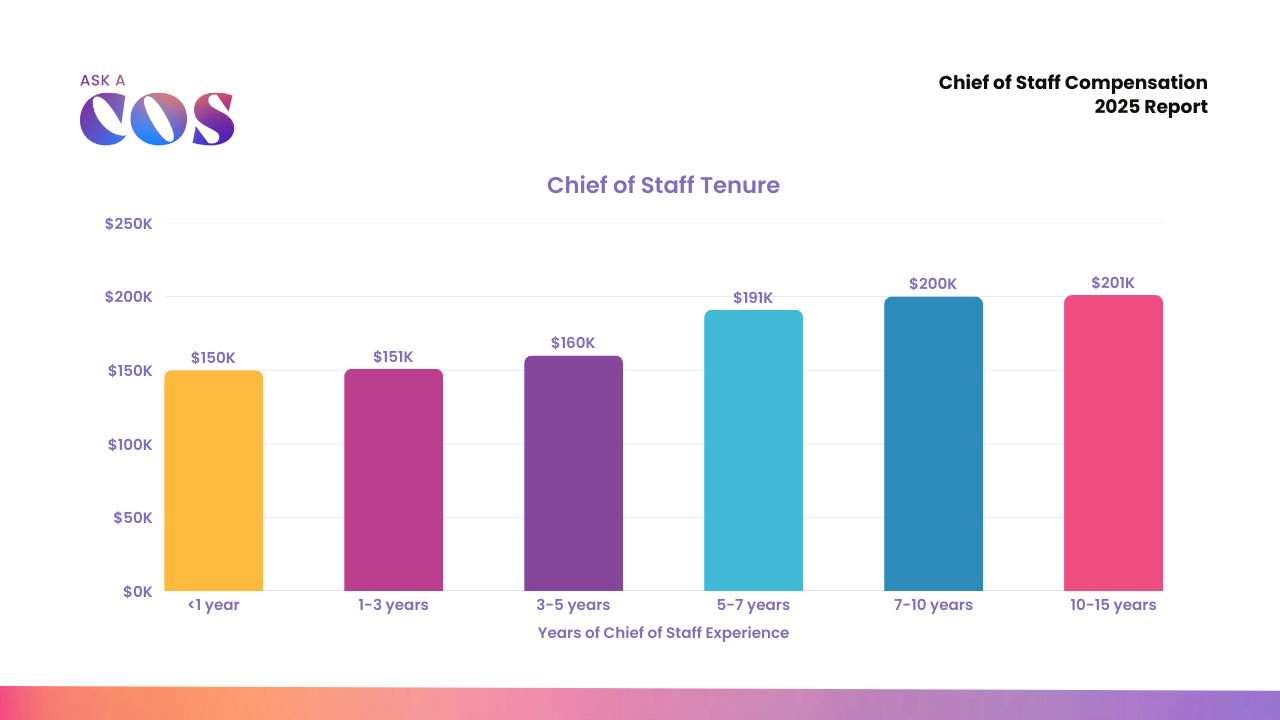
Those with less than one year in the role begin at a median salary of $150,000, with compensation climbing steadily to $200,000+ for those with 10+ years of Chief of Staff experience.
Notably, Chief of Staff-specific experience shows an even stronger correlation with salary than overall work experience, with the most significant jump occurring between the 5-7 year mark ($191,200) and 7-10 years ($200,000).
This trajectory highlights the increasing value organizations place on seasoned Chiefs of Staff who’ve mastered the unique demands of this role.
2️⃣ Reporting Structure Reveals Company Maturity
Chiefs of Staff reporting to non-CEO C-Suite executives earn significantly more than those reporting to CEOs.
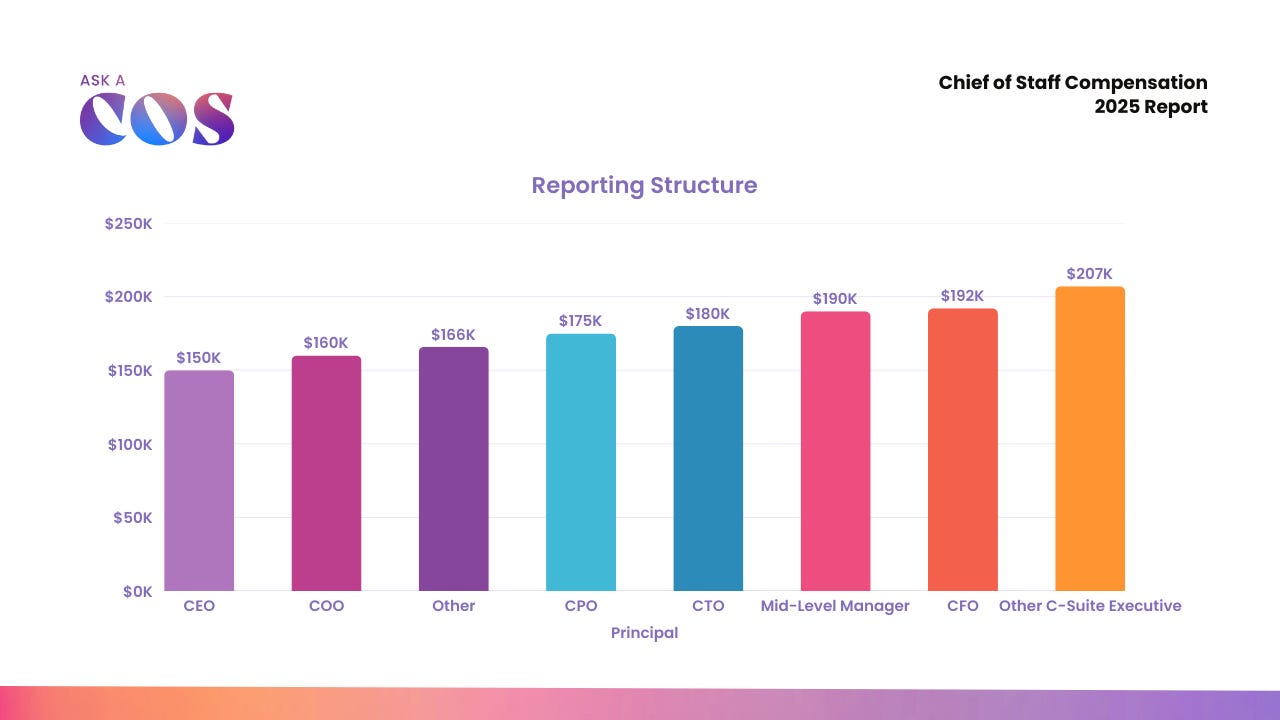
While this may appear surprising at first glance, it actually reflects company maturity. Roles reporting to specialized C-Suite leaders tend to be at later-stage, higher-budget companies with more established leadership teams, while CEO-reporting roles include many early-stage startups that skew the median lower.
3️⃣ Industry Creates the Widest Compensation Spread
Industry choice plays a critical role in Chief of Staff compensation, with a $55,500 spread between the highest and lowest-paying sectors.
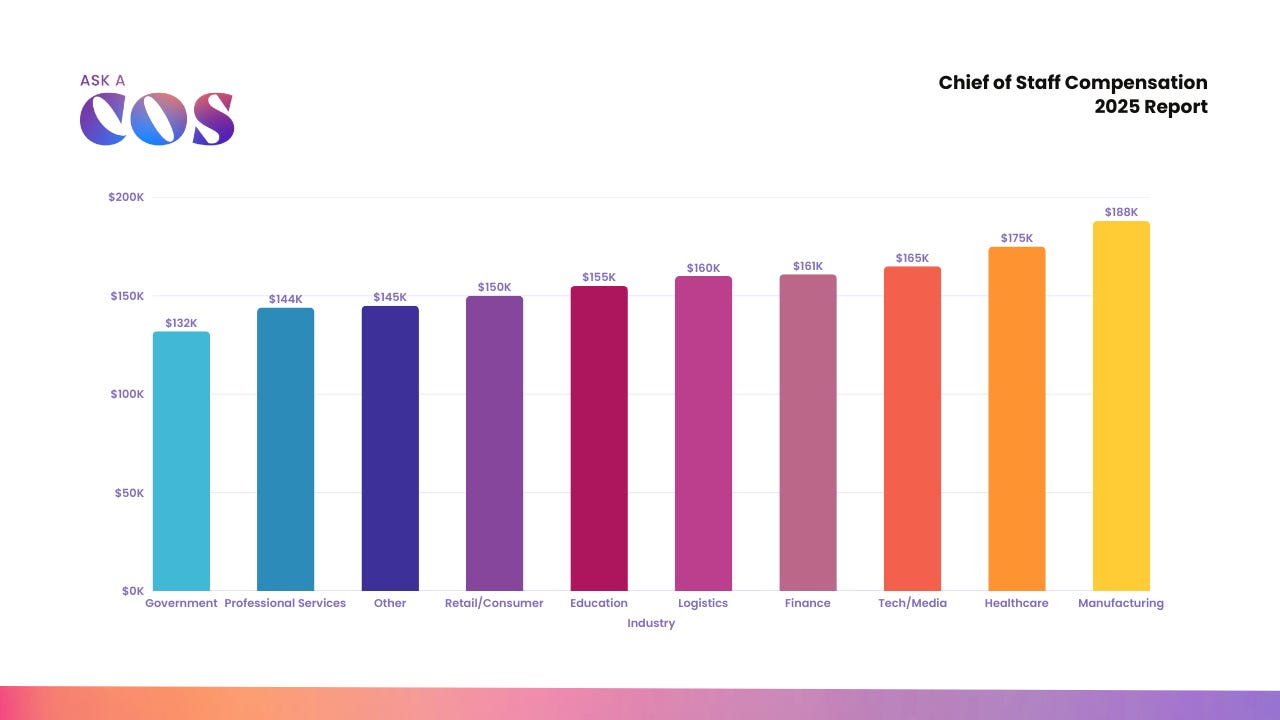
Manufacturing leads at $187,500, followed closely by Healthcare at $175,000 and Technology/Media at $165,000. On the lower end, Professional Services sits at $144,000 and Government roles lag significantly at $132,000.
This wide variance suggests that Chiefs of Staff should carefully consider industry selection when evaluating opportunities, as sector choice can have as much impact on compensation as years of experience.
4️⃣ Education Shows Diminishing Returns After Bachelor’s Degree
While education correlates with earning potential, the relationship isn’t always linear.
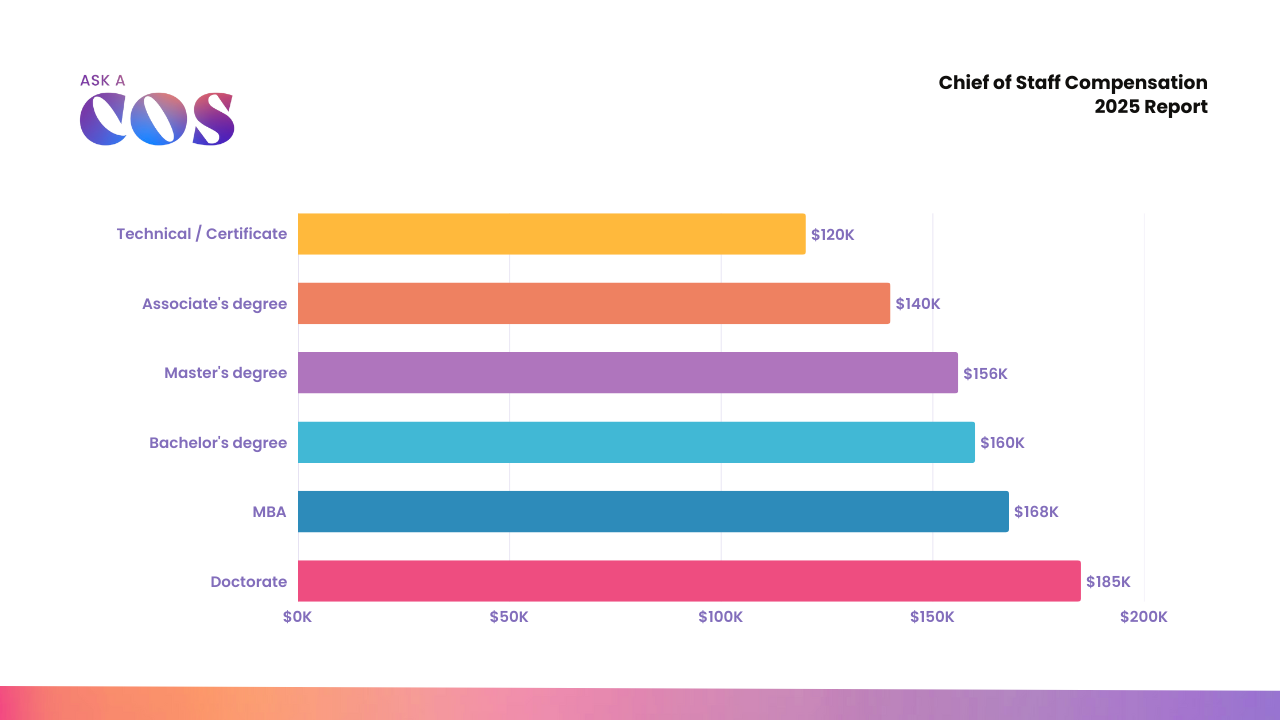
Doctorate holders command the highest median salary at $185,000, and MBAs earn $168,000. However, there’s a surprising inversion in the middle: Bachelor’s degree holders earn a median of $160,000, while Master’s degree holders earn slightly less at $156,000.
This reinforces a consistent finding from our surveys: practical experience in the Chief of Staff role often carries more weight than additional academic credentials, particularly advanced degrees that aren’t MBAs or professional degrees.
5️⃣ Company Stage Creates an $82,500 Compensation Range
The maturity and funding level of your company significantly impacts compensation.
Public companies offer the highest median salary at $200,000, while bootstrapped companies sit at the bottom at $117,500 - an $82,500 difference.
The progression through startup stages shows clear growth: Seed stage ($140,000) to Series A ($160,000) to Series B ($170,000) to Series C ($196,000) and Series D ($197,500). Late-stage private companies land at $190,000.
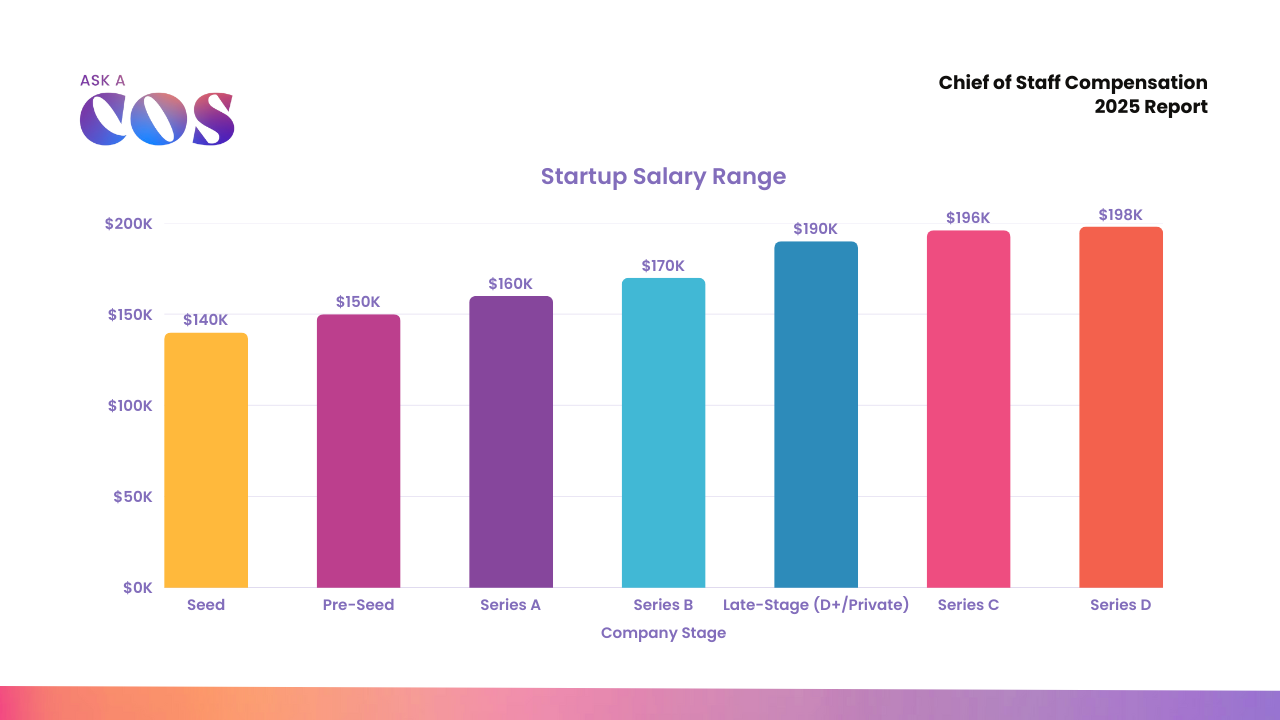
This data suggests that Chiefs of Staff can expect meaningful compensation increases as their companies mature and secure additional funding.
💜 Bonus: Gender Pay Gap Continues to Narrow
We’re encouraged to see continued progress on pay equity.
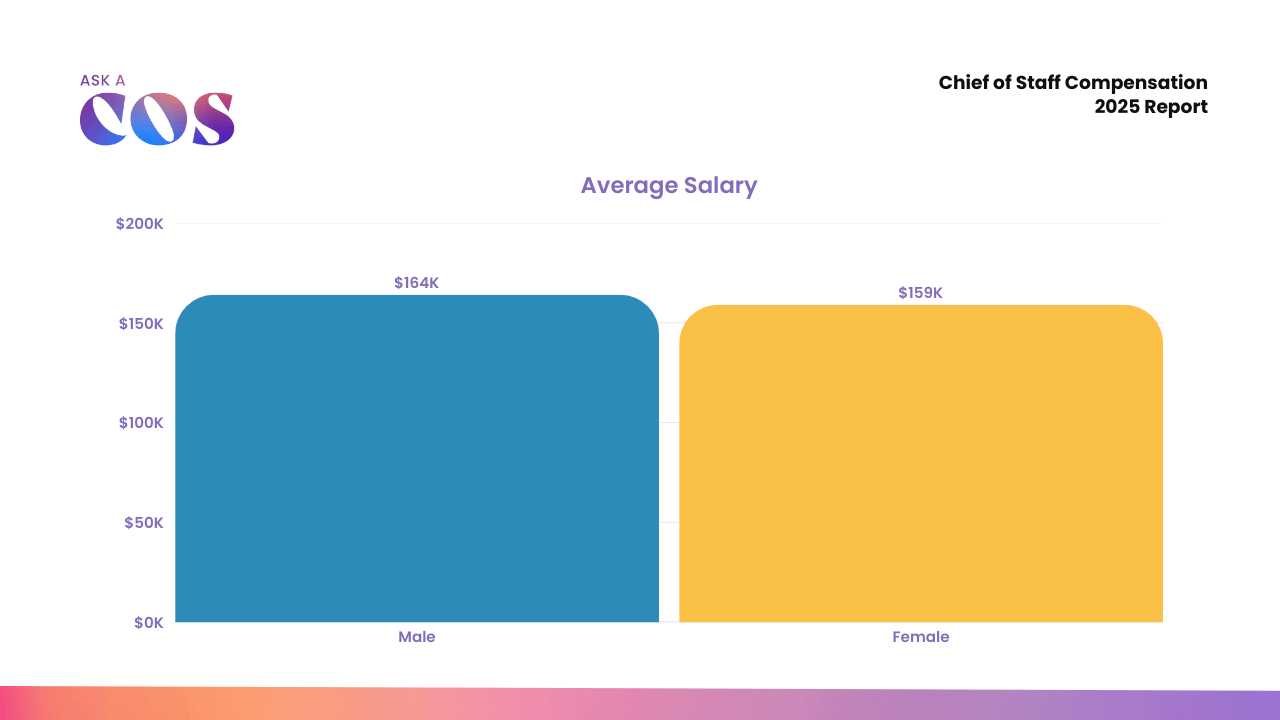
The median salary difference between male ($164,000) and female ($159,000) Chiefs of Staff is just $5,000 - or about 97 cents on the dollar.
While this represents a slight widening from last year’s $3,000 gap, it’s still significantly better than the broader market and shows relatively strong pay equity in the Chief of Staff profession. We remain committed to tracking this metric and working toward full parity.
⏭ So what?
Most Chiefs of Staff I talk to are flying blind when it comes to pay. There’s no classic ladder, no “standard” title progression, and very little clean benchmarking data to bring into a negotiation. That’s exactly why we run this survey every year.
A few ways to put it to work:
If you’re currently in a Chief of Staff role:
Locate yourself in the data: company stage, industry, location, reporting line, and years in role.
If you’re below the typical range for your band, use this as a starting point for a conversation, not a demand.
Bring one or two specific charts into your next review and ask, “Given where the market is for similar roles, how are we thinking about my compensation going into 2026?”
If you’re interviewing or about to transition:
Use the ranges to set your walk-away number and your ideal number before you get deep into a process.
Calibrate your expectations by stage and scope—Series A vs. Series D will (and should) look different.
Remember to look at total compensation: salary, bonus, equity, benefits, and what I call “time wealth” (flexibility, sustainability, realistic expectations).
If you’re an executive or HR leader reading this:
Gut-check whether your current or planned Chief of Staff compensation lines up with the realities of the market.
Use this data to set clear bands, write more honest job descriptions, and avoid under-leveling a role that you’re counting on to be strategic.
What our community has discovered over the years is that compensation clarity isn’t just about money: it’s about power, expectations, and sustainability. When Chiefs of Staff know what “normal” looks like, they can advocate for themselves, set better boundaries, and stay in roles that are actually aligned with the scope of work.
My hope is that this report gives you language and leverage: something concrete to point to the next time you’re talking comp, whether that’s a raise, a promotion, or a new role entirely.
And if this was helpful, share it with another Chief of Staff or a founder in your world. A rising tide really does lift all boats, and transparency is one of the fastest ways we can make this ecosystem better for everyone.
👥 Curious About the Ask a Chief of Staff Community?
We’re a bit biased, but we think that the Ask a Chief of Staff community is the best place find peers and a personal advisory board to help you become even more successful and effective in the role. Members get access to exclusive workshops with industry leaders, peer to peer networking, a mentorship directory with current and former Chiefs of Staff, in person events, and more!
P.S. Joining the Ask a Chief of Staff community is a fantastic way to use up any extra learning & development budget you have for the rest of the year! Pop on over to my LinkedIn page and send me the 🎁 emoji for a special end of year offer 😁

If you’ve enjoyed this issue, consider subscribing and sharing. Additionally, feel free to reply to this email with feedback on whether this was helpful to you and any suggestions you might have.
📚 Level Up Your Chief Of Staff Knowledge
Get access to a library of exclusive Ask a Chief of Staff workshops, with new videos added every month, when you become a paid Substack subscriber.
Check out a few of our past member exclusives and upgrade to unlock future workshops 👇


🎥 Upcoming Events and Workshops:
🗽🍎 LAST CHANCE for Early Bird Pricing on the 2026 Chief of Staff Summit! 🗽🍎
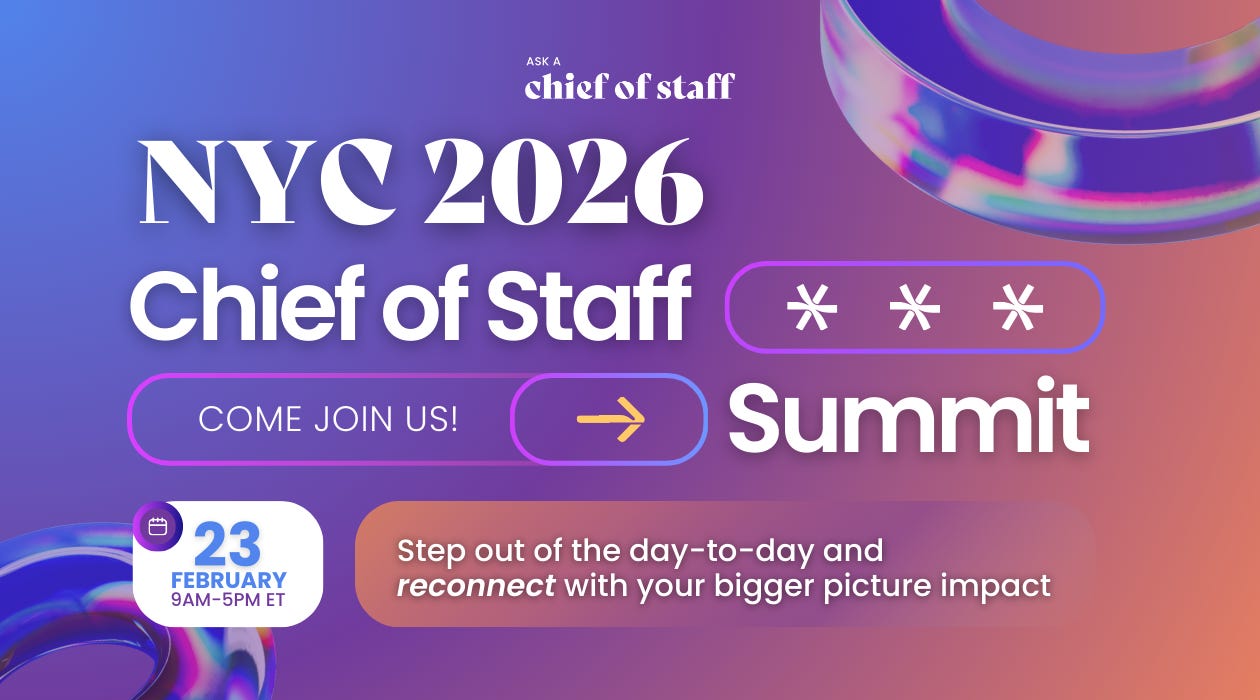
February 23, 2026 | NYC | Early Bird Pricing: $499 (until Dec 31)
Join us for a full-day, in-person summit designed exclusively for Chiefs of Staff at all stages of their journey to connect, learn, and grow together in the heart of NYC.
Ask a Chief of Staff readers can take an additional $50 off their ticket price with code AACOSREADER!
💻 Virtual Events
December 16th: Finding the Signal: How AI Makes Us Better Communicators
December 17th: Building Resilience: Staying Clear, Calm & Effective Under Pressure
👋🏼 In-Person Events
December 11th: Coffee and Co-Working at Industrious (NYC)
December 16th: SF Chief of Staff Holiday Dinner Party 💜
As a reminder, events and workshops are free or heavily discounted for all Ask a Chief of Staff community members.