
Issue 56: Managing Context Switching as a Chief of Staff
Ways to stay organized when every task feels urgent


Welcome back, aspiring and current Chiefs of Staff 👋🏼
If you're reading this as a forward or from LinkedIn, subscribe to Ask a Chief of Staff to get these insights directly in your inbox. Join 9,000+ Chiefs of Staff who trust us for actionable insights.
This week’s issue is brought to you by Airtable, the all-in-one platform that’s revolutionizing how Chiefs of Staff manage projects, track deliverables, and organize information.

As a Chief of Staff, you’ll love how Airtable helps you:
Create custom dashboards for executive updates
Track cross-functional initiatives in one place
Automate routine tasks and reporting
Build flexible databases for everything from vendor management to board meeting prep
Stop juggling multiple tools. Start working smarter. Try Airtable for free!
*Interested in sponsoring a future issue of Ask a Chief of Staff? Hit reply!
😵💫 How Can Chiefs of Staff Manage Context Switching & Stay Focused?
This week’s issue was inspired by a question I received from a community member that likely resonates with many of you:
“Tips and tricks when your job requires a lot of context switching over the course of the day/week? I work fully remote and often meet with execs, so I don’t always have the most control over my calendar and often find myself leading or attending back-to-back meetings where the topic switches. Any strategies for how to either switch between topics without feeling brain fog, or calendaring approaches to better sequence/manage the topics?”
It’s a challenge that sits at the heart of the Chief of Staff role, so I turned to our community for their tried-and-true strategies. A huge thank you to Claire Podulka, Elizabeth Barr-Jobson, Katherine Huang, Harry Siggins, and others who shared their insights and practical approaches.
🖼️ Picture this: You’ve just wrapped up a detailed financial review with your CFO, and in exactly two minutes, you need to pivot to a product roadmap discussion with the engineering team. 2️⃣ 0️⃣ after that, you’re facilitating a culture committee meeting, and somewhere in between, you need to process 4️⃣ 7️⃣ Slack notifications that accumulated during your back-to-backs. Sound familiar?
For Chiefs of Staff, especially those working remotely, context switching isn’t just an occasional challenge—it’s a fundamental part of the role. While the ability to move fluidly between different topics and stakeholders is part of what makes Chiefs of Staff invaluable, it also presents a unique cognitive challenge that requires very intentional self-management.
The Context Switching Challenge
The modern Chief of Staff role demands a delicate balance between being responsive to immediate needs and maintaining the mental clarity required for strategic thinking. As one community member, Elizabeth Barr-Jobson, puts it:
“I found that if I booked literally back to back, then someone always suffered. Either me or one of the people I was meeting with because I needed those breathers to be effective.”
The cost of constant context switching goes beyond mere fatigue. For Chiefs of Staff, who might switch contexts dozens of times per day, it presents a significant challenge to both productivity and effectiveness.
While we can’t eliminate context switching from the Chief of Staff role, we can be strategic about how we manage it.
The key lies in building systems and habits that support smooth transitions while protecting our mental and physical resources.
In this week’s issue, we’ll explore:
Calendar strategies for more effective context switching
Techniques to stay sharp during transitions
Systems for managing the unexpected
Habits to maintain physical and mental wellbeing
📅 Calendar Strategies For Better Context Switching
When it comes to managing context switching, your calendar is your first line of defense and most powerful tool. Even today, I’m ruthless about my calendar management. My EA knows not to schedule over lunch and to avoid booking meetings on Fridays since I need the no meeting days to catch up.
Strategic Meeting Blocks ⏰
Start by organizing your calendar to support your natural rhythms and energy levels.
Group similar types of meetings together to minimize mental transitions
Schedule complex or strategic work during your peak performance hours
Use color coding to quickly identify meeting types and required preparation
Build in buffer time between meetings to reset and prepare
“I live and die by calendar blocks and recommend these to my clients as well. It’s so crucial to take time to evaluate your meeting schedule vs. free time and block off dedicated time for larger projects, research, or whichever other task could otherwise fall by the wayside. I suggest labeling calendar blocks specifically and including any relevant links so you reduce the friction of getting started on that specific task.” -Katherine Huang, 2x Chief of Staff, Executive Coach
Smart Meeting Design 🎯
Small adjustments to how you structure individual meetings can have a big impact on your overall effectiveness.
Schedule 25 or 50-minute meetings instead of 30 or 60 to create natural transition time*
Use tools like Ambient to securely generate pre-reads, agendas, follow up emails and more.
Set clear agendas and expected outcomes in meeting descriptions
Connect your calendar to Slack to automatically update your status
Use recurring meetings strategically to create predictable rhythms in your week (also regularly audit recurring meetings to make sure they’re still relevant)
“I’ve gotten super diligent about having links in my calendar events for the tasks I’m going to work on then. Links to emails, slack threads, websites, docs/sheets - whatever I need to get me up to speed fast when the time comes.” -Elizabeth Barr-Jobson, Chief of Staff at Simplero
* Pro Tip: Have meetings start at 5 or 10 after the hour versus planning them to end 5 or 10 before the hour. It’s natural that once you’re into an interesting conversation, you could run over time. But starting “later” gives you the break before the meeting starts rather than forcing you to cut off a conversation mid-flow.
Setting Boundaries 🛡️
While Chiefs of Staff need to remain flexible, it’s also essential to establish–and maintain–clear boundaries.
During my time as a Chief of Staff, I did not have the Slack app on my phone - something that shocks the majority of Chiefs of Staff I’ve talked to. I also have badge notifications turned off. I remind people constantly that while your job is important, we’re not doing brain surgery. Giving yourself the time to be “off” on personal devices is so important and if something was truly urgent, my Principal had my phone number.
Block and protect focused work time for strategic projects
Remember: if you don’t stand up for your time, nobody will
Learn to say “no” firmly but professionally. For example, “I have held that time for productivity reasons, and it cannot be rescheduled."
Request to be included in recap emails instead of attending non-essential meetings
“I find that I get interrupted CONSTANTLY with Slack pings, emails, text and Telegram notifications, etc. It’s not always possible for me to turn them off. I’ve learned to be ruthless about what I actually read and switch to. If it’s not on fire urgent or critically important, I’ll read it just enough to decide ‘yes or no’ on it. It’s almost always no. But I have to be firm with myself.” -Elizabeth Barr-Jobson, Chief of Staff at Simplero
🧠 Techniques For Sharp Transitions
Even with the best calendar management, context switching demands significant mental energy. Developing strong transition practices helps you maintain clarity and effectiveness throughout your day.
Physical Reset Routines 🚶♀️
Small physical changes between tasks can help your brain register the context switch.
Stand up and stretch between meetings or take a short walk
Change your physical position or workspace when possible
Look away from screens periodically to rest your eyes
Use transition time to handle quick household tasks
“In a perfect world, I do some kind of physical transition between tasks. I stand up to get a drink of water, do some stretches, maybe even take care of something menial at home like throw in a load of laundry, to allow my brain processing/switching time while still ‘getting stuff done’ because life is busy like that.” -Claire Podulka, Chief of Staff at TXI
Workspace Management 💻
Your physical and digital environment also plays an important role in smooth context switching. If you work remotely, make sure you have a dedicated work area for deep working and thinking. While it may be tempting to work from bed (and that’s ok for low effort tasks like answering emails!), having a specific place for when your best work is done gives your brain a chance to “switch on” into “hard work mode.”
Keep only relevant tabs open for the current task
Organize documents and links by project or meeting
Create clear verbal or written markers between tasks
Take quick notes about next steps before switching
Keep a running priority list to stay oriented
“To get started on a new task and switch contexts, I like the Pomodoro technique, which I apply a simple version of by starting the stopwatch and seeing if I can work for 5 or 10 minutes initially on a task that has been on my plate for a while. That’s often enough to get myself into the flow and knock the task off my to-do list.” -Katherine Huang, 2x Chief of Staff, Executive Coach
🌊 Managing The Unexpected Without Losing Your Flow
Every Chief of Staff knows that unexpected switches are inevitable and can be jarring. The key is to build flexibility into your systems. Give yourself the time to react to unknowns and if nothing happens during that time, you get it back!
Planning for Change 🎲
Set yourself up for success by making adaptability part of your daily plan.
Leave strategic gaps in your calendar for urgent matters
Keep a running list of tasks that can be done in short bursts
Document ongoing projects clearly so you can quickly pick them up again
Have templates ready for common urgent requests
“I typically outline tasks and prioritization the night before, considering calendar and personal objectives. Usually, assume that there’s an 80% chance it goes to plan, with a 20% expectation that at least something changes. If you can expect a slight change, it’s easier to manage when it happens.” -Harry Siggins, former Chief of Staff
Quick Recovery Strategies ⚡
When unexpected switches occur, use these techniques to maintain momentum.
Take 30 seconds to document where you’re leaving off
Set a clear stopping point in interrupted work
Keep important reference materials easily accessible
Communication Tactics 💬
Clear communication helps manage expectations with your team during unexpected transitions.
Let stakeholders know when you need to context switch
Set realistic timelines for returning to interrupted work
Update project trackers to reflect new priorities
Establish clear criteria for what constitutes an urgent interrupt
“Be transparent with others. I say something like, ‘My head has been in this thing and I’m not as up to speed on the thing we have this meeting about as I’d like. Can you give me two minutes to refresh my memory and then walk me through what’s top of mind for you about it?’” -Elizabeth Barr-Jobson, Chief of Staff at Simplero
🧘♀️ Healthy Habits To Reduce Stress
Regardless of what systems and processes you implement during your work day, it’s essential to prioritize your mental and physical wellbeing to avoid burnout.
Protect a consistent sleep schedule
Take breaks to close your eyes and practice deep belly breathing to reset your parasympathetic nervous system
Stay hydrated throughout the day to maintain mental clarity
Build in quick stress-release activities like stretching or yoga
⭐ Bringing It All Together
As Chiefs of Staff, our ability to move fluidly between different contexts is both our superpower and our greatest challenge.
That financial review, product roadmap discussion, and culture committee meeting? They’re all important, and with intentional practices, you can bring your best to each by:
Structuring your calendar to support your natural rhythms
Creating consistent transition routines that work for you
Building in flexibility for the unexpected
Communicating openly about your needs
Taking care of yourself
The goal isn’t to switch contexts faster—it’s to maintain effectiveness while preserving your energy for what matters most. Start by implementing one strategy from this article today, and build from there!
📚 Level Up Your Chief Of Staff Knowledge
Get access to a library of exclusive Ask a Chief of Staff workshops, with new videos added every month, when you become a paid Substack subscriber.
Check out a few of our past member exclusives and upgrade to unlock future workshops 👇


🎥 Upcoming Events and Workshops:
💻 Virtual Events
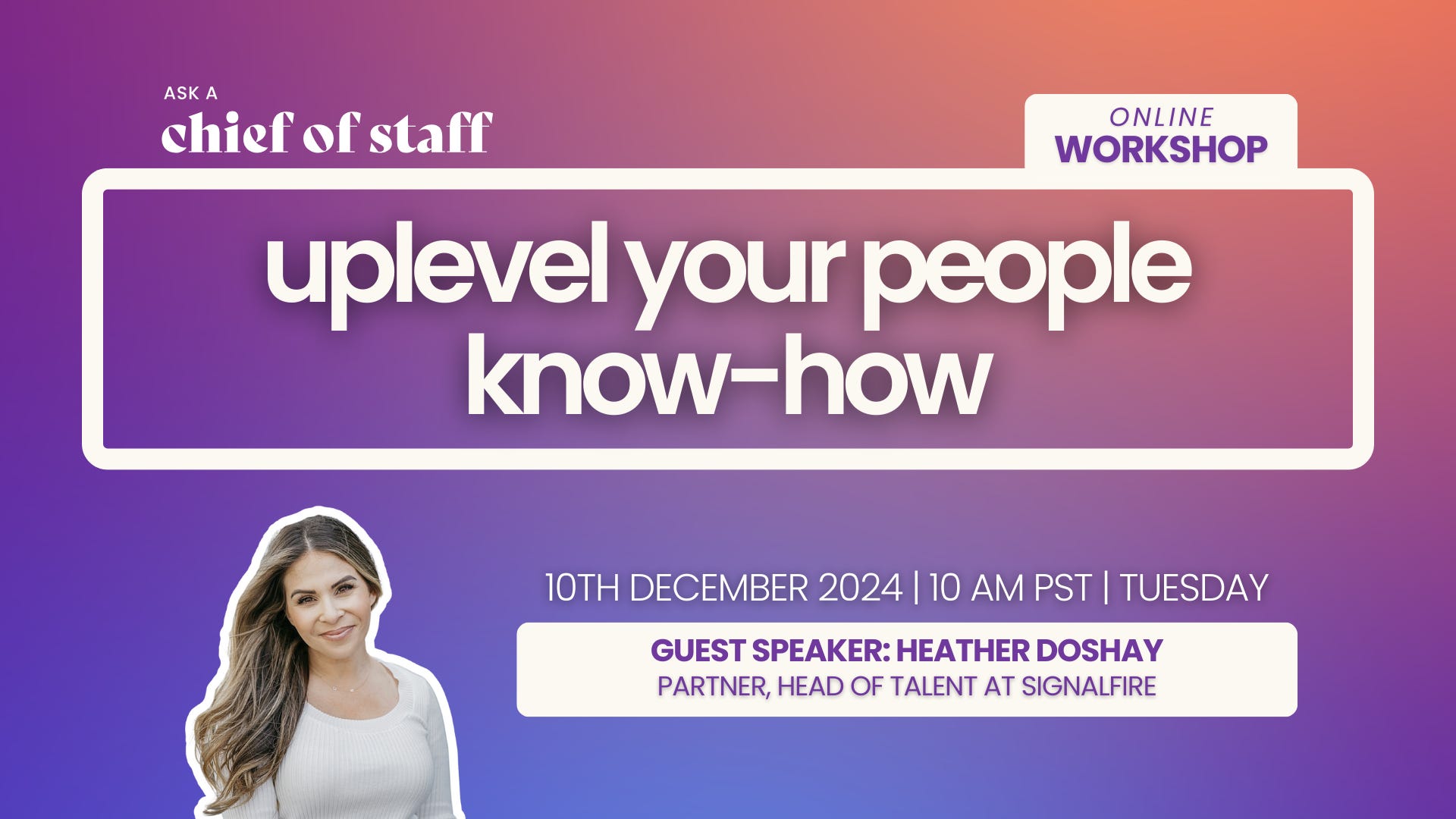
December 10th: Up Level Your People Know-How: AMA with Heather Doshay
January 9th: Give Your 2025 Job Search an Energy Boost
January 21st: Experience Design Accelerator for Chiefs of Staff
👋🏼 In-Person Events
December 4th: ❄️ NYC Chief of Staff Holiday Dinner Party
December 11th: ☕️ Coffee and Co-Working at Industrious
January 17th: 🎇 SF Chief of Staff New Year Dinner Party
As a reminder, events and workshops are free or heavily discounted for all Ask a Chief of Staff community members.
💼 Open Roles:
Looking for a new Chief of Staff role? Check out the 🔟➕ Chief of Staff roles we’re hiring for. Just a small sample of some of the jobs we’re helping hire for below:
🍝 𝗖𝗵𝗶𝗲𝗳 𝗼𝗳 𝗦𝘁𝗮𝗳𝗳 𝘁𝗼 𝗮 𝗙𝗼𝗼𝗱 𝗖𝗼𝗻𝘁𝗲𝗻𝘁 𝗖𝗿𝗲𝗮𝘁𝗼𝗿
Remote (Boston/NYC preferred)
3-4+ years of overall experience
Interest in food health/wellness industry
Strong project management and organizational skills with a detail-oriented approach
Proven track record of taking ownership of diverse initiatives and scale operations
Ability to manage contractors
Comfortable being strategic and tactical—someone who can operate at multiple levels and wear various hats as needed
𝗧𝗮𝗿𝗴𝗲𝘁 𝗦𝗮𝗹𝗮𝗿𝘆: $120K - $140K (Contract to hire)
🎤 𝗖𝗵𝗶𝗲𝗳 𝗼𝗳 𝗦𝘁𝗮𝗳𝗳 𝗮𝘁 𝗮 𝗩𝗼𝗶𝗰𝗲 𝗔𝗜 𝗣𝗹𝗮𝘁𝗳𝗼𝗿𝗺
In Person SF
3-5+ years of overall experience
Experience with early-stage startup or a consulting background with a technical degree
Experience defining and building processes and improving efficiency across departments
Experience working cross functionally (with finance and the board, preparing marketing presentations, legal, accounting, etc.)
𝗧𝗮𝗿𝗴𝗲𝘁 𝗦𝗮𝗹𝗮𝗿𝘆: $100K - $150K + equity
💻 𝗖𝗵𝗶𝗲𝗳 𝗼𝗳 𝗦𝘁𝗮𝗳𝗳 𝗮𝘁 𝗮 𝗗𝗮𝘁𝗮 𝗖𝗲𝗻𝘁𝗲𝗿 𝗜𝗻𝗳𝗿𝗮𝘀𝘁𝗿𝘂𝗰𝘁𝘂𝗿𝗲 𝗖𝗼𝗺𝗽𝗮𝗻𝘆
Hybrid in Minnesota
4-5+ years of overall experience
Ideally has construction or data center operations experience or has worked in adjacent industries
Experience managing both strategic and operational tasks with strong project management skills
Ability to take ownership of diverse initiatives, scale operations, and manage subcontractors
Experience driving special projects such as warehouse space, inventory management, and vertical integration
𝗧𝗮𝗿𝗴𝗲𝘁 𝗦𝗮𝗹𝗮𝗿𝘆: $120K - $140K + profit sharing
💻 𝗔𝘀𝘀𝗼𝗰𝗶𝗮𝘁𝗲 𝗮𝘁 𝗮 𝗕𝗼𝘂𝘁𝗶𝗾𝘂𝗲 𝗖𝗼𝗻𝘀𝘂𝗹𝘁𝗶𝗻𝗴 𝗙𝗶𝗿𝗺
Hybrid, NYC (3x a week)
2-3+ years of experience
Strong business acumen
Experience in consulting (big firm or niche-specific firms) or a blend of research and practical work.
This role is ideal for someone looking to accelerate their career with exposure to diverse industries and complex organizational challenges, ultimately preparing them for a senior leadership position like Chief of Staff.
In your paragraph, include something you’re passionate about.
𝗧𝗮𝗿𝗴𝗲𝘁 𝗦𝗮𝗹𝗮𝗿𝘆: $90K - $120K
If you’re interested, submit your application with the button below. If there isn’t a role that catches your eye right now, submit a “General Interest” application and we’ll reach out if we have something that’s a fit in the future!
Thanks for reading Ask a Chief of Staff! Know another Chief of Staff who would benefit from this issue? Share it with them!
As I was reading this was the advice rolling through my head, which was pleasant to see. One thing I would add is like the hydration, quality eating is huge if you want to mitigate brain fog. I'm not a doctor but I would advocate looking into Organic Non-GMO C8 MCT oil. It does wonders with brain fuel and staving off brain fog.